EPISODE 157 HARMONIC PROGRESSION PT. 13 ALL SEVENTH CHORDS
HOST- Jeremy Burns, Matthew Scott Phillips
GENRE- Ear Training
DURATION- 70:01
BUMPER MUSIC-"Progression Full of Seven" (Area 47)
ANNOUNCER- Mike Cunliffe
LISTEN
DESCRIPTION
This ear training episode will be like many others. The difference? All chords (except the tonic) will be full 7th chords! Will these additions muddy up our analysis? Let's find out!
KEYWORDS
DIATONIC- When a triad, chord or melody consists of notes solely from the given key, it is considered
to be DIATONIC.
TONIC ( I )- A note in a melody or a chord in a progression based on scale degree 1 of the given key.
SUPERTONIC ( ii )- A note in a melody or a chord in a progression based on scale degree 2 of the given key.
MEDIANT ( iii )- A note in a melody or a chord in a progression based on scale degree 3 of the given key.
SUBDOMINANT ( IV )- A note in a melody or a chord in a progression based on scale degree 4 of the given key.
DOMINANT ( V )- A note in a melody or a chord in a progression based on scale degree 5 of the given
key.
SUBMEDIANT ( vi )- A note in a melody or a chord in a progression based on scale degree 6 of the
given key.
SUBTONIC ( VII )- A note in a melody or a chord in a progression based on scale degree b7 of the
given key.
LEADING TONE ( vii°)- A note in a melody or a chord in a progression based on scale degree 7 of the
major key or #7 of a minor key.
SEVENTH (7)- This would be the 4th chord tone added to a TRIAD. It will be a 7th above the root of
the given chord. It can be major, minor, augmented or diminished.
SECONDARY DOMINANT ( V/ )- This chord can act as a dominant function to a chord other than the
tonic.
NEAPOLITAN CHORD (N or bII)- This is a major chord based on scale degree ,2 in major or minor.
*It should be noted that all the above Roman numeral examples given were shown as uppercase
(major) or lowercase (minor) as they relate to the MAJOR SCALE, as seen below:
I - ii - iii - IV - V - vi - vii° - I
In the MINOR SCALE, the diatonic chords will be
built as seen below:
i - ii° - III - iv - v - VI - VII - i
EXAMPLES
THE DIATONIC CHORDS IN MAJOR
Below are the DIATONIC chords in C major. Each note in each chord is a member of the C major scale. Think not of the letter names of these chords, rather the quality of the chords (major, minor, etc) based on the scale degrees (1, 2, 3, etc.).
The chords above are all TRIADS (3 note chords). However, below, we have added a fourth note to each chord (the 7th of each chord) to create the DIATONIC seventh chords.
THE DIATONIC CHORDS IN MINOR
Below are the DIATONIC chords in D minor. Each note in each chord is a member of the natural D minor scale. Instead of the chord names, we remind you of the FUNCTIONS of these chords (tonic, supertonic, etc.). Again, think not of the letter names of these chords, rather the quality of the chords (major, minor, etc) based on the scale degrees (1, 2, 3, etc.).
Below, we have added a fourth note to each chord (the 7th of each chord) to create the DIATONIC seventh chords of the natural minor scale.
FOR MORE DETAILED DISCUSSIONS OF THE DIATONIC CHORDS,
CHECK OUT EPISODE 16
LET'S LISTEN
Let's take four listens to identify this chord progression.
Below is a good strategy on how to use your listens wisely for each time the progression is played.
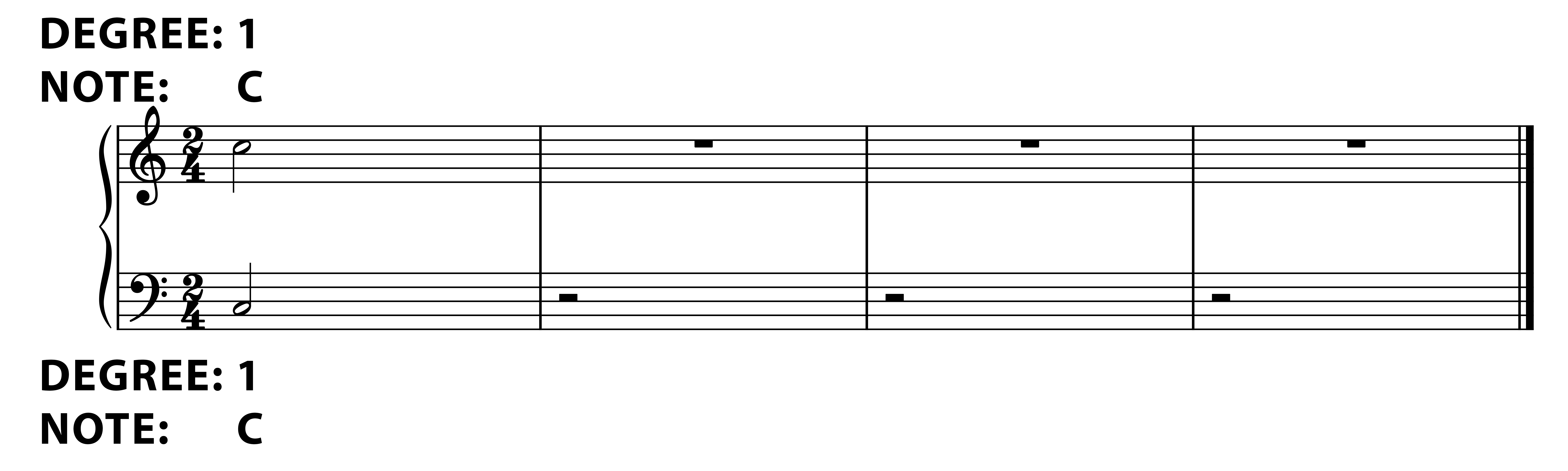
We have been given the key (C major).
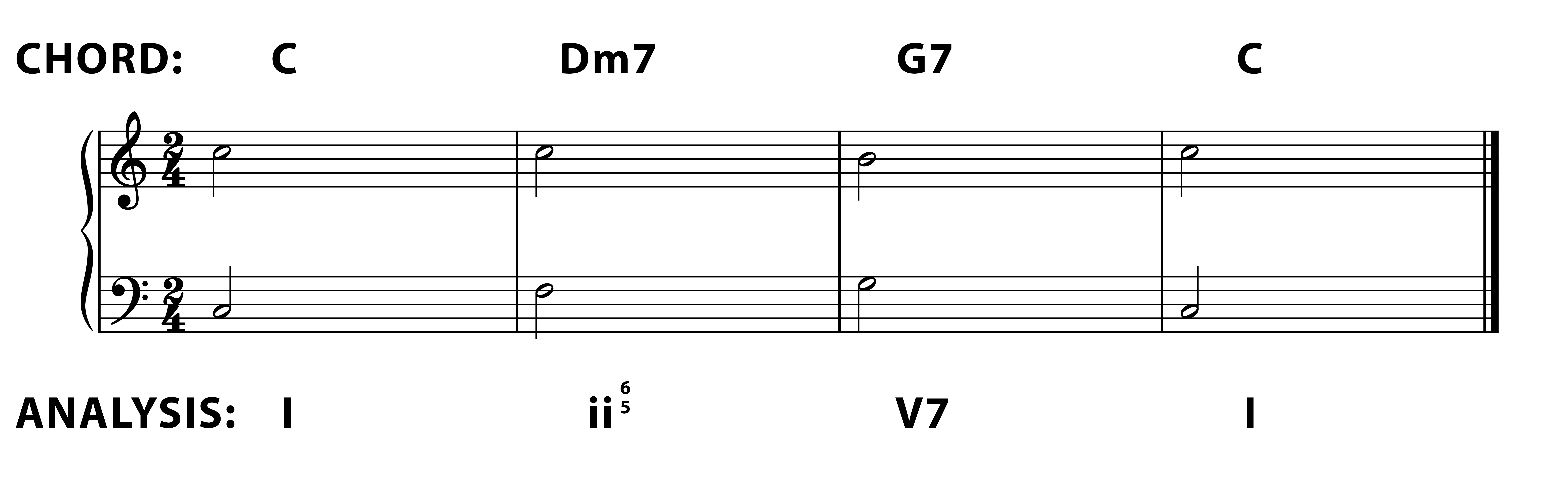
We have been given the 1st note in the bass (C) and the soprano (C).
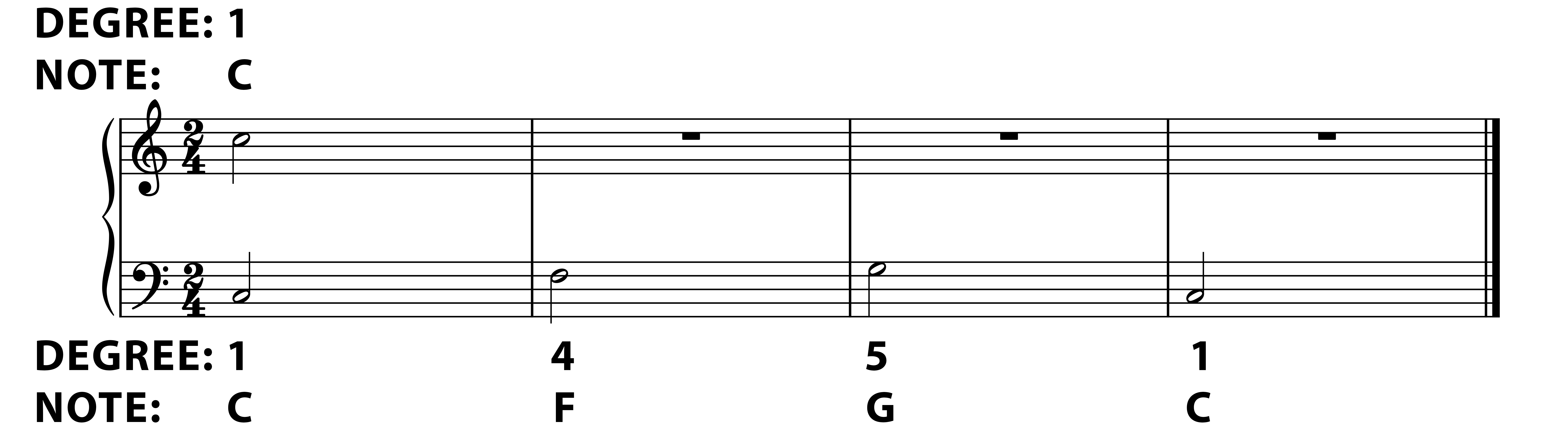
1st LISTEN- THE BASS
Use this listen to focus on the bass line.
In our first example, we hear the following scale steps in the bass, beginning with scale degree 1 (C):
1 - 4 - 5 - 1
Notate it!
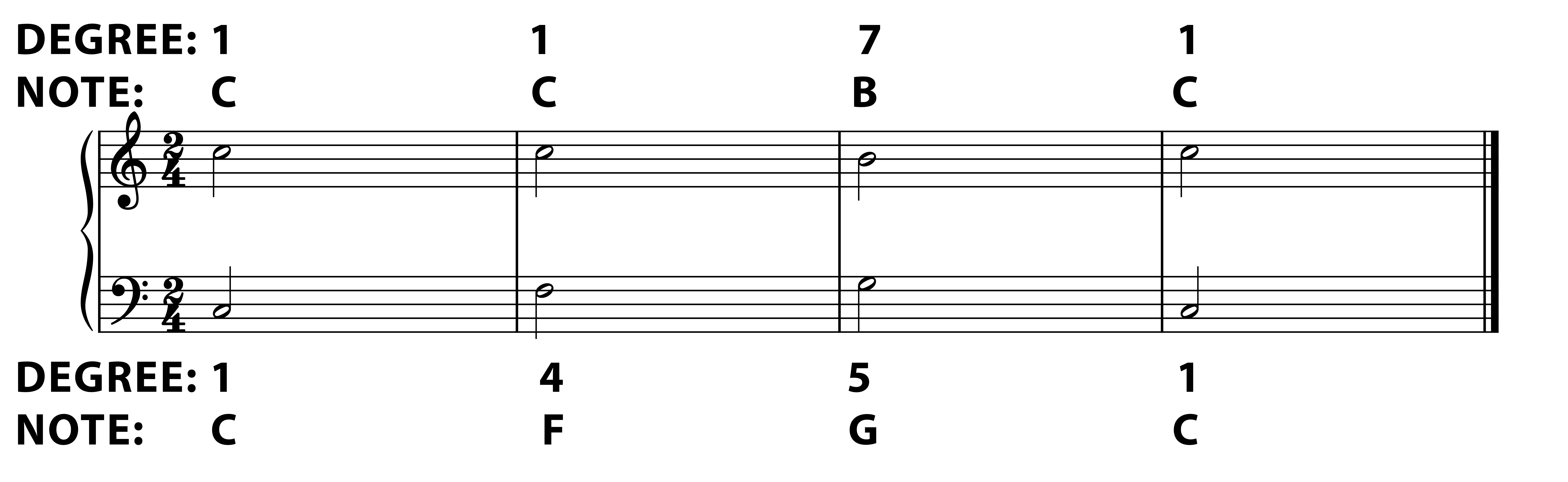
2nd LISTEN-THE HIGHEST NOTE
Use this listen to focus on the melody or the soprano voice.
When you hear that note, try to identify what scale degree it is and where it goes from there.
In this case, we hear that scale degree 1 begins the following progression in the highest voice:
1 - 1 - 7 - 1
Notate it!
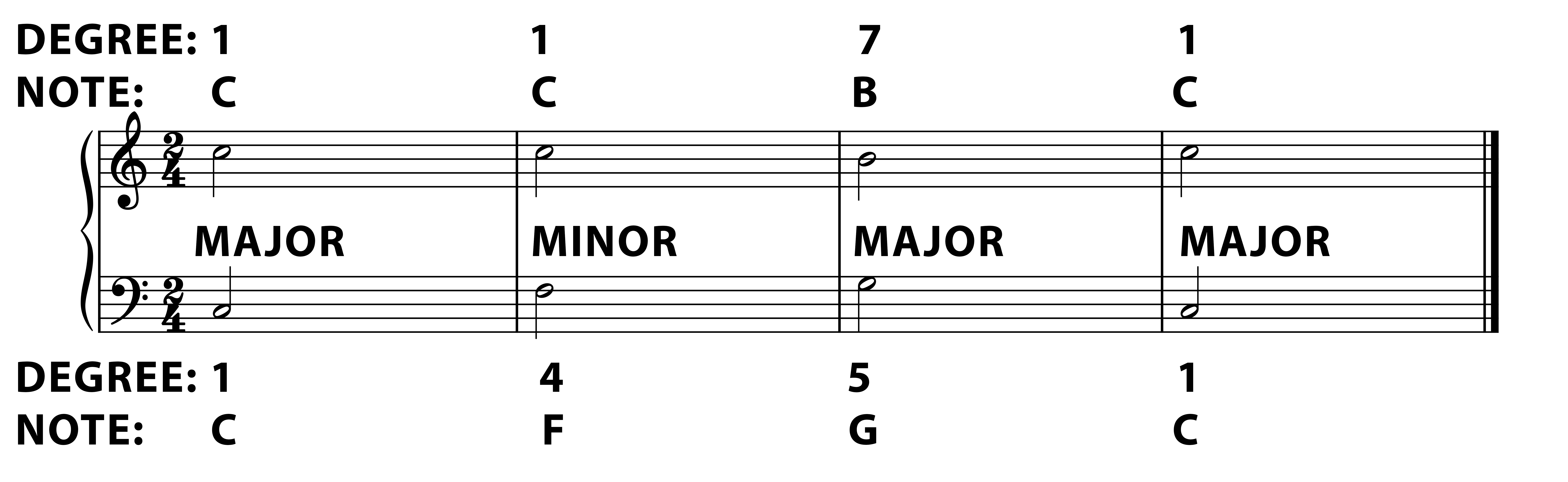
3rd LISTEN-THE THEORY BRAIN
Something harmonic is coming together! We now have enough information to ENGAGE OUR THEORY BRAIN and start making educated guesses at how this progression might develop. Here's an example of the process:
-1st CHORD- Has two notes from the tonic chord (C and C) and sounds like a major chord. The tonic is in the bass as well. Let's call it I.
-2nd CHORD- With an F in the bass and a C in the soprano one could guess this to be IV chord. However, it sounds minor. Those two notes are also present in the ii7 chord. Perhaps this is a ii7 chord. Because the 3rd (F) is in the bass, this chord is in first inversion.
-3rd CHORD- This chord is major. The two notes we have identified are G (5) in the bass and B (7) in the soprano. This sounds like a 7th chord and the following chord gives us a sense of resolution. Let's call this a V7 chord.
-4th CHORD- Finally, we have a major chord that includes scale degrees 1 and 1 (C and C). Both of these notes are in the C major chord (the tonic). We feel resolution when we hear this chord. This must be the I chord.
4th LISTEN-CONFIRMATION
Ideally, this listen will be your confirmation listen. Here's what it will look like:
NOW LISTEN AS WE APPLY THIS APPROACH TO THE NEXT EXAMPLES
THINGS TO REMEMBER
-When trying to determine which scale degree is in the highest voice, try singing down the scale from that note. If you feel you've reached the TONIC on the 3rd note down, that note is the 3rd. If you can keep going, perhaps not.
-Try practicing progressions using these chords, using CHORALE or KEYBOARD styles.
-Don't neglect the MINOR keys while working on these progressions.
-Try to get good at singing "in your head" or to your self. When you hear a chord, try to arpeggiate the notes in your head.
-Try to get good at identifying the bass lines when listening to music. These will be the first that you will want to identify when taking your listening exams.
-Budget your listens wisely. First identify the lowest notes. Second, identify the highest notes. Use the third listen to engage your theory brain and then the fourth to confirm.