EPISODE 155
ORCHESTRATION-WOODWINDS PT. 2
HOST- Jeremy Burns, Matthew Scott Phillips
GENRE-Theory
DURATION- 80:00
BUMPER MUSIC-"The Individual and Their Society" (Matthew Scott Phillips)
ANNOUNCER- Mike Cunliffe
LISTEN
DESCRIPTION
On episode 154, we began a discussion on orchestration for the woodwinds section and it's instruments: the flute, the oboe, the clarinet, the saxophone and the bassoon. We will now continue this discussion with a focus on suggested ratios for arrangement, ranges and more detail on the instruments themselves!

RATIOS FOR THE WOODWIND SECTION
CLASSICAL PERIOD
(2,2,2,2)
- 2 Flutes
- 2 Oboes
- 2 Clarinets
- 2 Bassoons
ROMANTIC PERIOD
(3,3,3,3)
- 2 Flutes, 1 Piccolo
- 2 Oboes, 1 English Horn
- 2 Clarinets, 1 Bass Clarinet
- 2 Bassoons, 1 Contrabassoon
LARGE
(4,4,4,4)
- 3 Flutes, 1 Piccolo
- 3 Oboes, 1 English Horn
- 3 Clarinets, 1 Bass Clarinet
- 3 Bassoons, 1 Contrabassoon
SCORING FOR THE WOODWINDS SECTION
-Generally, two instruments of the same type are written in the same staff. For example, two flutes will be on one staff.
-In the case above, the first flute will have stems up and the second flute will have stems down.
-A'2 ("a due") will be notated if the two instruments were meant to be played in unison (same melody in the same octave).
-Notating the number 1 or the number 2 over a passage determines which instrument (first or second) was intended to play the passage.
-When dividing sections in the woodwind family, don't use "divisi" (as that's mainly intended for strings).
RANGES
FLUTE FAMILIY
-The instruments of the Flute family are highly agile and sensitive. Below are the ranges and descriptions of their sounds.
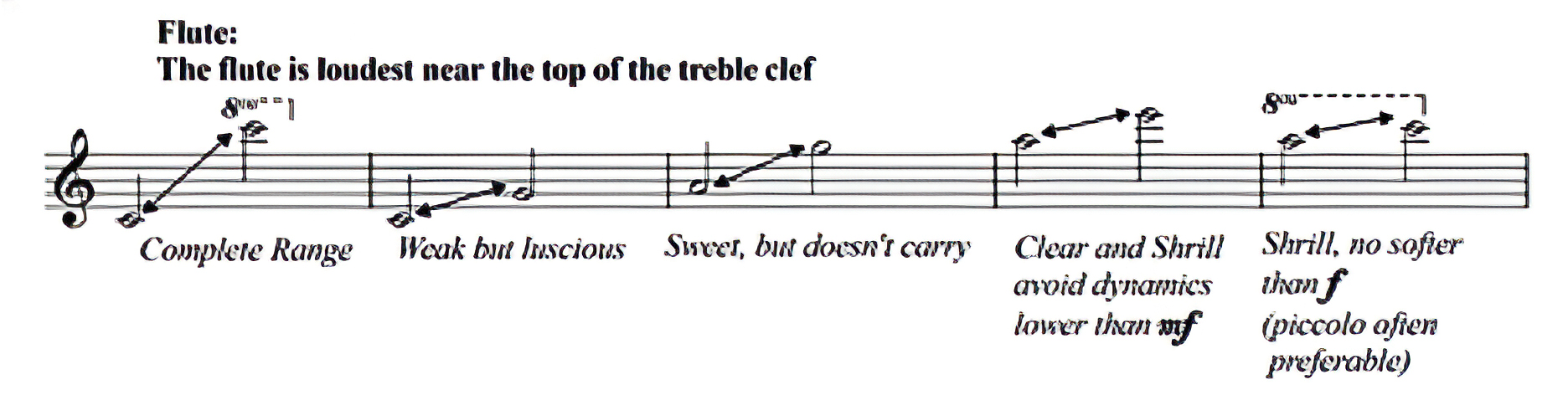
-The piccolo has the same registral characteristics but is transposed an octave higher than written.
-Often the first flautist of the orchestra will double on a piccolo.
-Most flutes can actually play the B below Middle C by use of a “B foot” mechanism.
-Flutes are “C instruments” meaning they do not transpose. The note you see is the note you get.
-The alto flute is a transposing instrument. It play a P4 lower than written. So a written C = sounding G.
-The bass flute play the same range as a standard flute but plays an octave lower than written.
OBOE FAMILIY
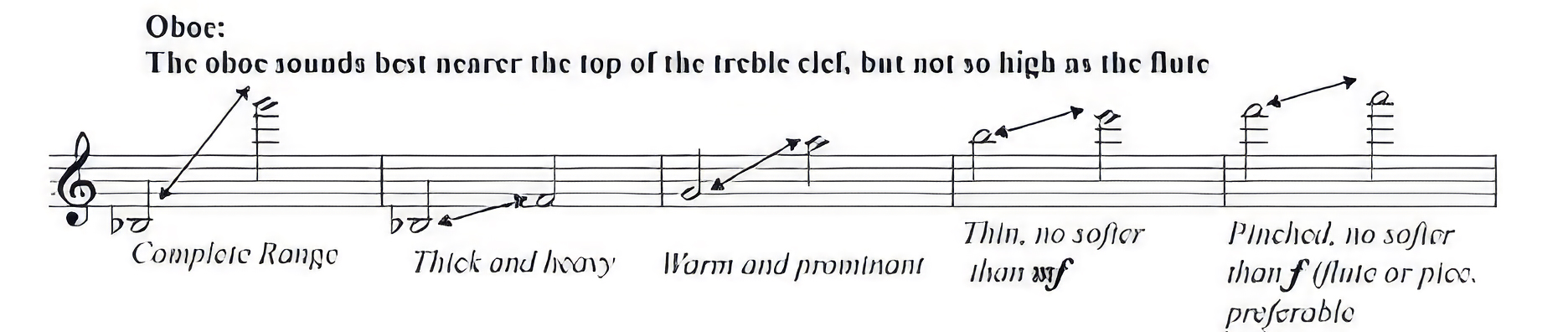
-The oboe’s most effect range is from F to high C of the treble clef. In this range it sounds warm and reedy. Below it can sound thick, and doesn’t carry well. Above it can sound thin and pinched.
-In its higher ranges, softer dynamics are not possible.
-Extremely fast repeated notes are not particularly idiomatic.
-The English horn (Cor Anglais) is a transposing instrumnet. Transposes down a P5 (from C to F). Otherwise has the same range as the oboe.
-The oboe d’amore transposes down a minor 3rd (from C to A). It has a bulb like bell at the end and produces a gentler sound than the standard oboe.
CLARINET FAMILIY
-Clarinets can play in any range at any dynamic.
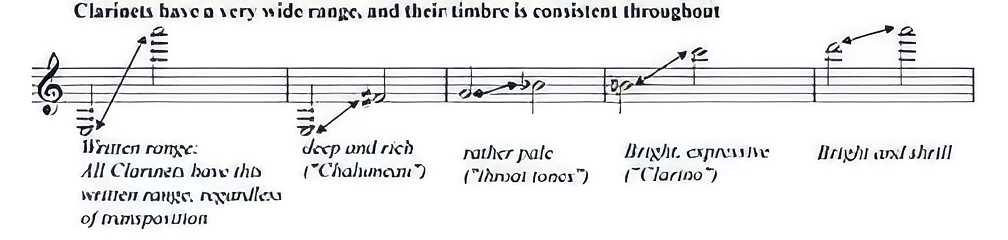
-The lowest written note on all clarinets is E3. But the clarinet is transposing.
-The Bb and Eb clarinets are best for flat keys.
-The A and D clarinets are best for sharp keys.
-The Eb clarinet sounds a minor 3rd above written. Makes a great high solo instrument.
-The clarinet takes more breath to play, so frequent rests should be given when composing lines.
-The bass clarinet is written in treble clef like all clarinets, but sound an octave +M2 below written (so like a Bb clarinet, but an octave below that).
SAXOPHONE FAMILIY
-The saxophone family ranges are very much like those of the clarinet.
-The soprano saxophone is transposed to the Eb a m3 up from middle C.
-The alto saxophone is transposed to the Eb a M6th down from middle C.
-The tenor saxophone is transposed to the Bb a M9 down from middle C.
-The baritone saxophone is transposed to the Eb a M13 down from middle C.
BASSOON FAMILIY
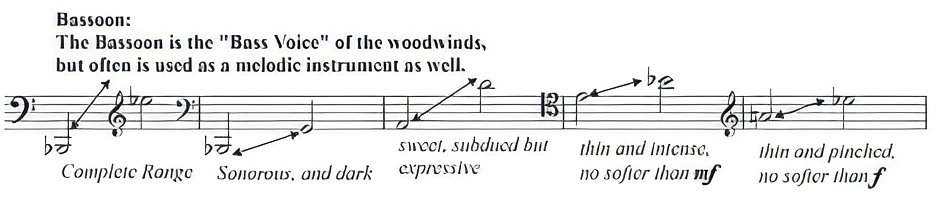
-The bassoon is the bass instrument of the woodwind section, and is written in bass clef (also sometimes tenor clef).
-All bass intruments are C instruments (non transposed).
-The contrabassoon transposes an octave below the bassoon and is the lowest sounding instrument in the orchestra.
THE ROLE OF WOODWINDS
PROVIDER OF MELODY- The woodwinds work very well for melody. If the strings have been taking the lead for a bit, consider passing the role over to the woodwinds.
-Unison doubling is a useful technique. Note that a2 (unison doubling) changes the timbre of winds as much as strengthens the part.
-Octave doubling can often more effective than unison doubling.
HARMONIC ACCOMPANIMENT-Winds often provide pedal style accompaniment in chords.
-Overlapping wind instruments from highest to lowest is most common. But be sure prominent melody note is in a good register for the instrument.
-Interlocking chords is the most creative way of writing chords in winds, but be careful of the registers.
-These same principles should be used with multiples for each instrument.
AS A CONTRASTING COLOR- One obvious use of the winds is to provide color that contrasts with the string section. Also consider using the woodwinds to double the strings.
RESOURCES
-The lecture notes for this episode drew from a number of texts and sources. Among them,
"The Study Orchestration"
by Samual Adler, comes highly recommended.