BUMPER MUSIC-"La Melodia Dulce" (Matthew Scott Phillips)
ANNOUNCER- Mike Cunliffe
LISTEN
DESCRIPTION
Orchestration is the art of choosing the right instruments, and the proper balance thereof, for a composition.
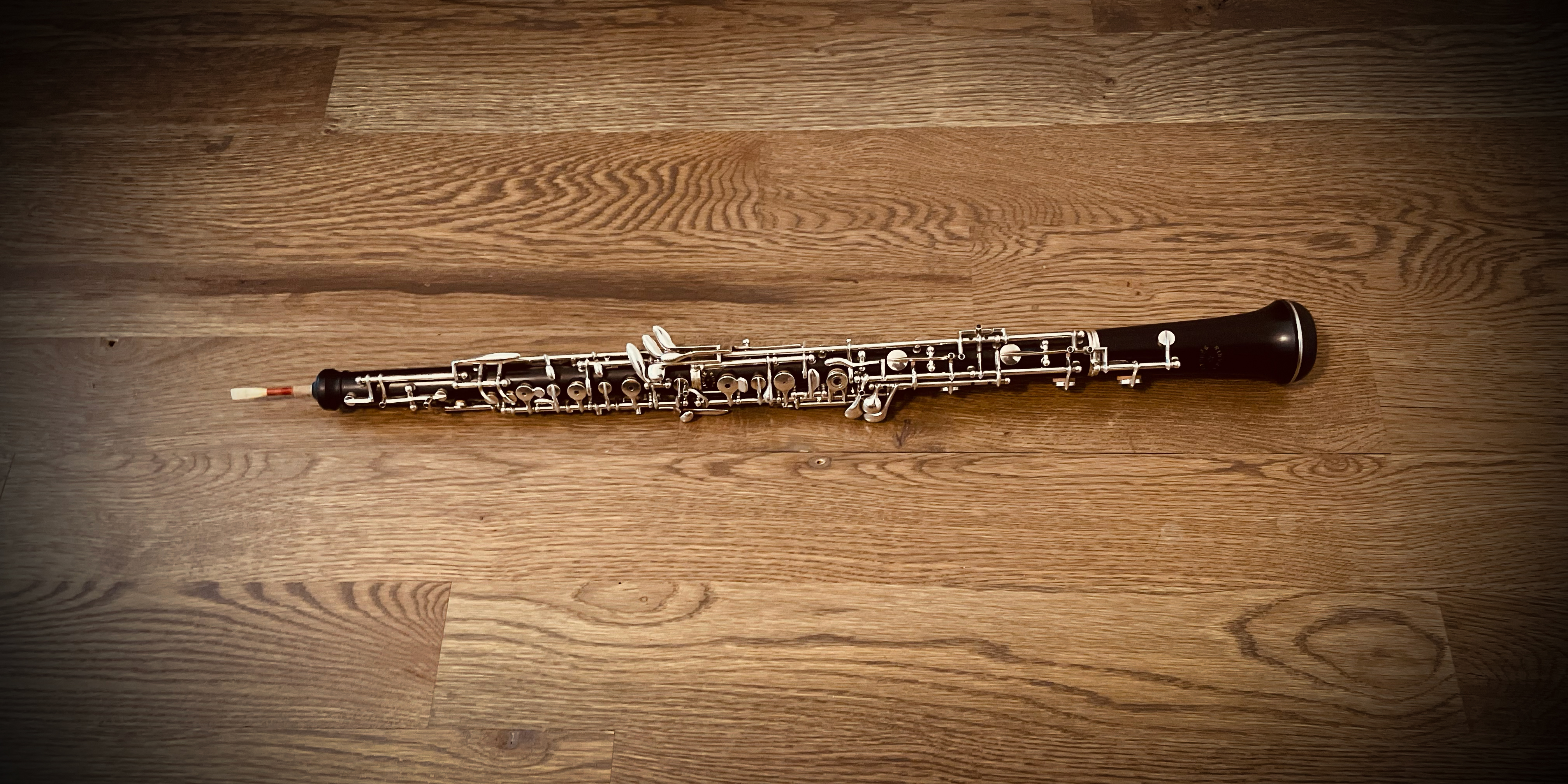
Different considerations go into conveying different moods and emotions to better tell the story. Continuing our discussion, we move on to the ever versatile woodwind section. Let's talk about the instruments: flutes, clarinets, oboes and saxophones!
Photo credit: Emily Zhang 2026
CONSTRUCTION
-All woodwinds produce musical notes via the vibration of a column of air. The amplitude of that column of air is expressed through a tube with a conical opening.
-To play different semitones, holes are cut in the tubes at exactly the right mathematical proportions. Valve mechanisms are then constructed over the holes to make them easily reachable with the fingers.
-Today, most any note, trill, tremolo etc. can be played on winds. They can play vary acrobatically, playing super fast runs, and large leaps with no problems.
-The woodwind family consists of many different timbres, with discriptions ranging from clear, smooth and mellow to sharp and cutting. They are acrobatic, in that they can make large interval jumps and produce fast and busy melodies.
CLARINET FAMILY (Single Reed):
-C Clarinet
-D Clarinet
-Eb Clarinet
-Bb Clarinet
-A Clarinet
-Alto Clarinet (Eb)
-Bass Clarinet (Bb an octave below the Bb clarinet)
-Contrabass Clarinet (Bb an octave below the bass clarinet)
SAXOPHONE FAMILY (Single Reed):
-Soprano Sax (Bb an octave above tenor sax)
-Alto Sax (Eb)
-Tenor Sax (Bb)
-Baritone Sax (Eb an octave below the alto sax)
*The clarinet and saxophones are known as TRANSPOSING INSTRUMENTS. Transposing instruments produce different pitches from what is written on the score. It is up to the arranger/composer to transpose the music properly so that the wind player can finger the instrument naturally, and yet play the correct notes. So if the written note is C, and you play a C on a Bb clarinet, it will sound as a Bb. Try to get used to the idea of "written pitches" vs "sounding pitches".
PLAYING TECHNIQUES
There are a good number of techniques and effects we can use to make these instruments sound more musical, less sterile and can convey certain moods or personalities to enhance the listeners experience.
-Vibrato: Caused by movements of the jaw, throat muscles, or in the case of bassoons, abdominal muscles, or combinations thereof. If no Vibrato is desired, the composer/arranger would notate “Senza Vibrato” ("without vibrato"). To reinstate, they would notate “Con Vibrato” ("with vibrato") or “ord.” (ordinary).
-Tonguing: Moving the tongue on the note as if saying the word "tuh". When no slurs are present, each note is tonged. If a slur is present, you only tongue the first note within the slur.
-Staccatto: Articulate a very short note with a quick attack and a quick release.
-Soft Tonguing: A very undistinguished tounge that barely separates the same notes repeated under a slur.
-Double Tonguing: In very fast passages double, or triple tonguing will happen.
-Flutter Tounge: This trilling technique can be accomplish by breaking a steady flow of air into a series of microbursts.
-Glissandi: Most successful on clarinet and saxophone. Usually a chromatic glissandi, but can also do a pitch slide by about a M2 by bending the read. But many players would rather not bend there reeds.
-Key Clicking: Just as is sounds, slapping keys without passing air through.
-Wind Tones: Blowing air without producing a pitch, resulting in a whispering effect.
-Flute Harmonics: Some harmonics can be produced by altering the position of your embouchure relative to the fipple or by rotating the fipple.
LINKS AND RESOURCES
-The lecture notes for this episode (based on Dr. Phillips lecture) drew from a number of texts and sources. Among them,
"The Study Orchestration" by Samual Adler, comes highly recommended.