BUMPER MUSIC- "Shadow and Self" (Matthew Scott Phillips)
ANNOUNCER- Mike Cunliffe
LISTEN
\
DESCRIPTION
What is polytonality? Can a piece of music be in more than one key at a time? Where do atonality and polytonality differ? What does this music even sound like? If you have any of these questions in mind, join us!
KEYWORDS
POLYTONALITY- If a piece, or passage, of music is considered "polytonal" it can have more than one percieved tonal center (key).
ATONALITY- If a piece, or passage, of music is considered "atonal" it has no percieved tonal center (key).
POLYCHORDAL- When two or more chords are present at the same time.
PITCH CLASS- Each note on the scale (begining with C) is assigned a number. C=0, C#=1, D=2, etc. The pitch class is immovable (C will always be 0) and also includes all octaves of said class (C1, C2, C3, etc. will always be pitch class 0).
PITCH COLLECTION- This a collection of pitch classes. Scales and modes could be considered pitch collections.
SUPERPOSITION- A superposition is a combination of 2 chords, based on the distance between their roots and uneffected by chord quality or inversion. There are 11 possible superpositions that can come from the chromatic scale.
DARIUS MILHAUD
In 1923, Darius Milhaud (French composer) published his treaty “Polytonalité et Atonalité" ("Polytonality and Atonality"). This treaty suggests that "we must bring to light the possibilities of superimposing multiple keys and allowing them to be heard simultaneously." He refers to this as "polytonality" and goes on to destinguish it from atonality, which was taking off in Germany during this period.
SUPERPOSITIONS
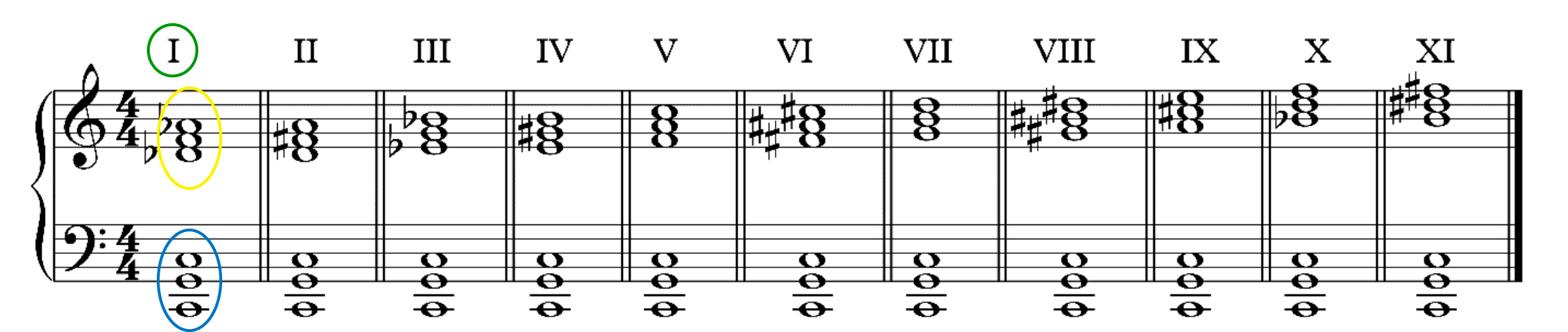
Milhaud came up with a system of chord combinations based on the distances of the roots between the chords involved. He referred to these as SUPERPOSITIONS. C major, alone, is merely C major. If you add a C# (Db in the example below) major on top of that C major, we have superposition I. If instead you add a D major (or even a D minor) to that C major chord, then we have superposition II...and so on. The chart below shows all possible superpositions within the chromatic scale.
-You will see that all the chords in the bass clef are the same chord (C with no 3rd).
-What changes from measure to measure are the chords in the treble clef.
-The combinations of these two chords make up the 11 possible superpositions (displayed as Roman numerals above).
-The qualities (major, minor, augmented, diminished) and all possible extensions of these chords (7th, 9th, 11th, etc.) are irrelevant.
The potential inversions of these chords are irrelevant. What matters is the distance from the roots of the two chords.
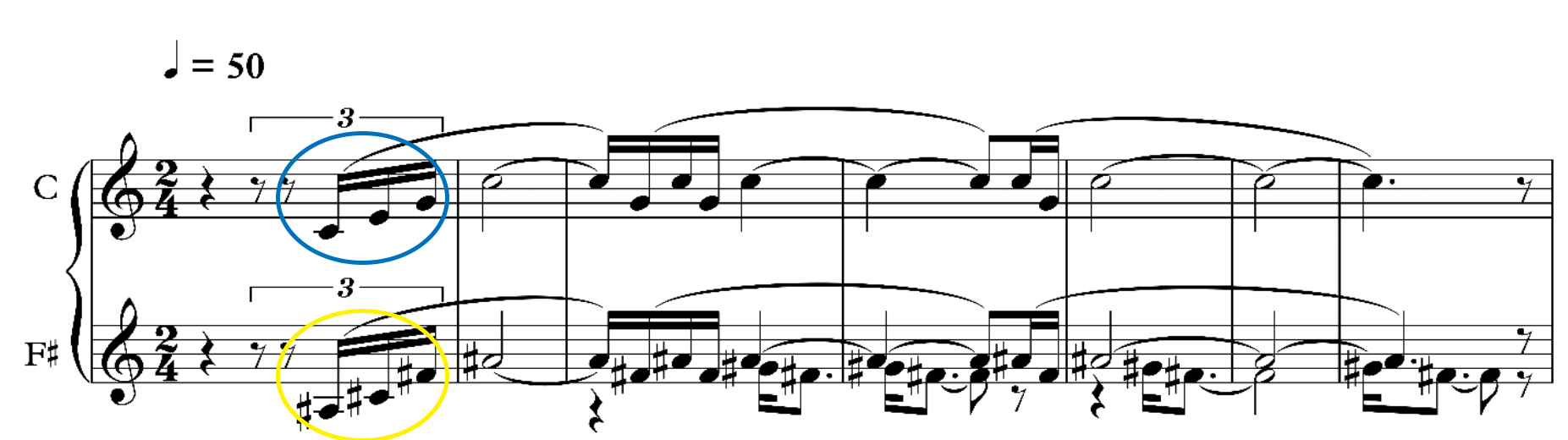
Milhaud sites this passage from Stravinsky’s ballet, "Petroushka" as an example of superposition VI. In the first measure below, we see an F# major chord in the bottom staff and a C major chord in the staff above. The distance between C and F# is 6 semitones. Therefore, this combination would be that of superposition VI.
PIETER VAN DEN TOORNE
Pieter van den Toorne was a theorist who disputed this suggestion of polytonality, regarding this passage from "Petroushka". Instead he maintained that this moment was merely a PITCH COLLECTION, or a subset, based on the octatonic scale. And he wasn't wrong about that. This octatonic scale was fairly common in Stravinsky’s music and all six notes involved did come from an octatonic scale. But he went further to say, "a simultaneous unfolding of separate ‘tonalities’ or ‘keys’ is not a part of our perceptual experience" and that such notions are “real horrors of the musical imagination”.
THE SCIENCE
A few scientist ran some experiments to test some of these ideas and maybe determine if one can perceive more than one key at a time.
-In 1986, Carol L. Krumhansl and Mark A. Schmuckler conducted a series of experiments, based on the Petroushka chord, investigating “listeners' capacities for perceiving ‘polytonality. In this case, they found that, in general, the listeners could not percieve two different chords. But one issue with this was that they were talking about the Petroushka chord. Milhaud could've probably argued this to be POLYCHORDAL (two chords occuring at once), it's hard to find any sense of 2 keys (a.k.a POLYTONAL) occuring within this small excerpt. The problem from van den Toorne's arguement is that one piece is hardly sufficient evidence to argue against polytonality.
-In response to Krumhansl and Schmuckler’s findings, William Forde Thompson and Shulamit Mor conducted experiments of their own based on two excerpts by Dubois and Milhaud. These experiments start from the hypothesis that other polytonal excerpts, which do not exhibit the parallelisms of rhythm and contour found in the Petroushka passage, may allow for the greater perception of two distinct key centers. Their studies concluded that under these circumstances people could determine more than one tonal center, with one usaully having a bit more "weight" to it (being easier to identify) than the other.
-This concept of keys having different levels of perceived importance in a musical texture is carried further by Peter Kaminsky, who states that polychords “come into being according to whether, and to what extent, the treble can resist assimilation by the bass and retain its own distinct identity and priority.” The more dissonant a note is with the bass, the more "RESISTANT" is becomes. From this he follows, the key with more notes in the bass voice carry more "weight" and that the other key claims more independence by "resisting the bass" (a.k.a. having fewer common tones with the first key).
EXAMPLES
"SOROCABA"
(from "Saudades do Brasil" by Darius Milhaud)
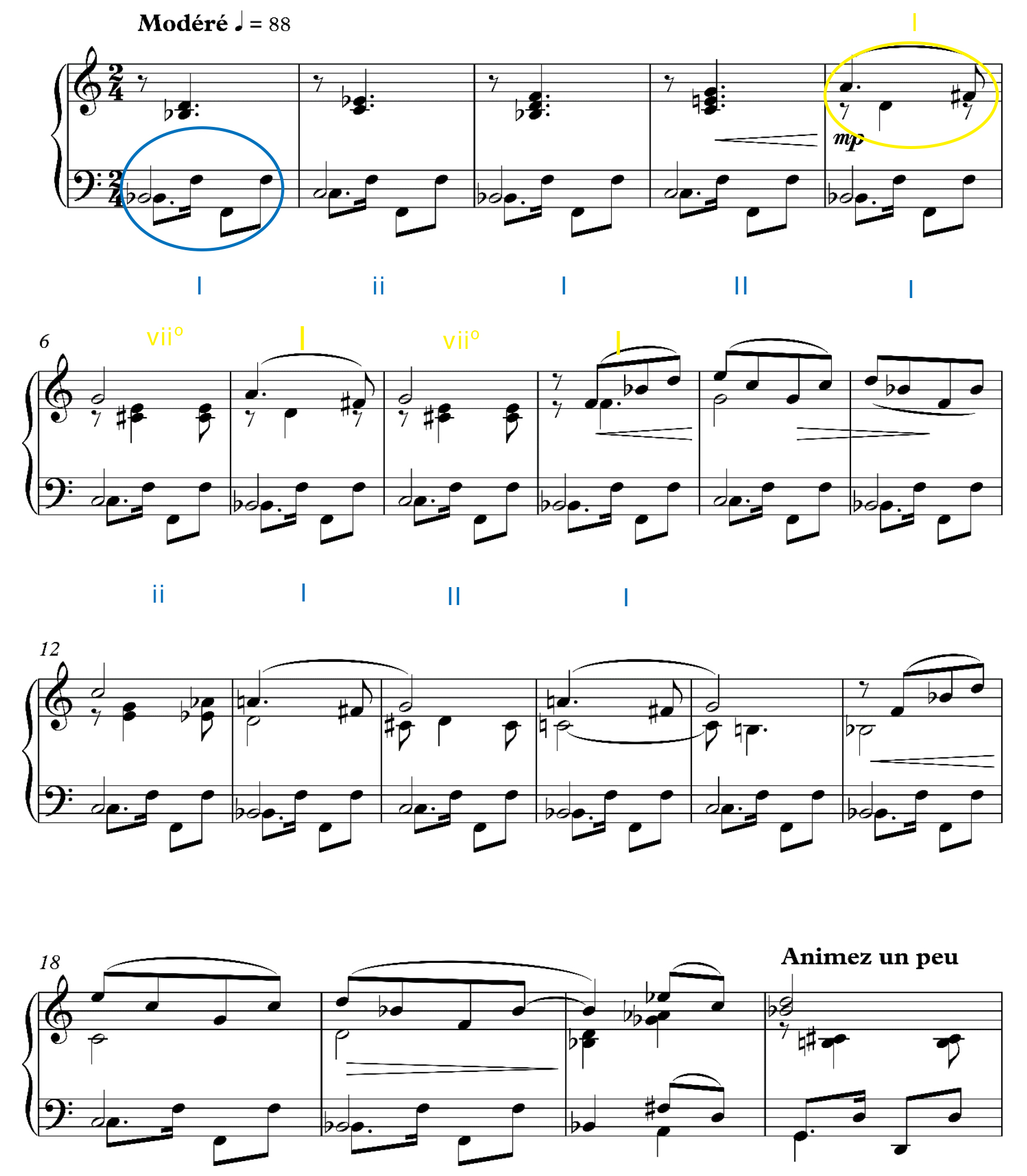
-In this piece, by Milhaud, a bassline begins the piece and establishes the key of Bb in the left hand. This is done by alternating the I and II chords, by measure. In this genre, the II chord will often function as a dominant.
-In the right hand, in measure 4, the melody begins and establishes the key of D major. This is done by alternating between I and viiº. In this case, the viiº is functioning as a dominant.
-As it turns out, both the lower voice key and the upper voice key are both alternating between tonic and dominant functions at the same time.
-Because of this complimentary pattern (tonic and dominant in both voices at the same times) and becasue these two keys have 3 pitch classes in common, the melody key of D major doen't "claim a lot of independence" from the initially established Bb.
-In this case, we will call Bb the "controlling" pitch class collection (has it has more "weight") and D major the "subcentral" collection. In this case, the subcenter collection was born from the controlling collection.
BOTAFOGO
(from "Saudades do Brasil" by Darius Milhaud)
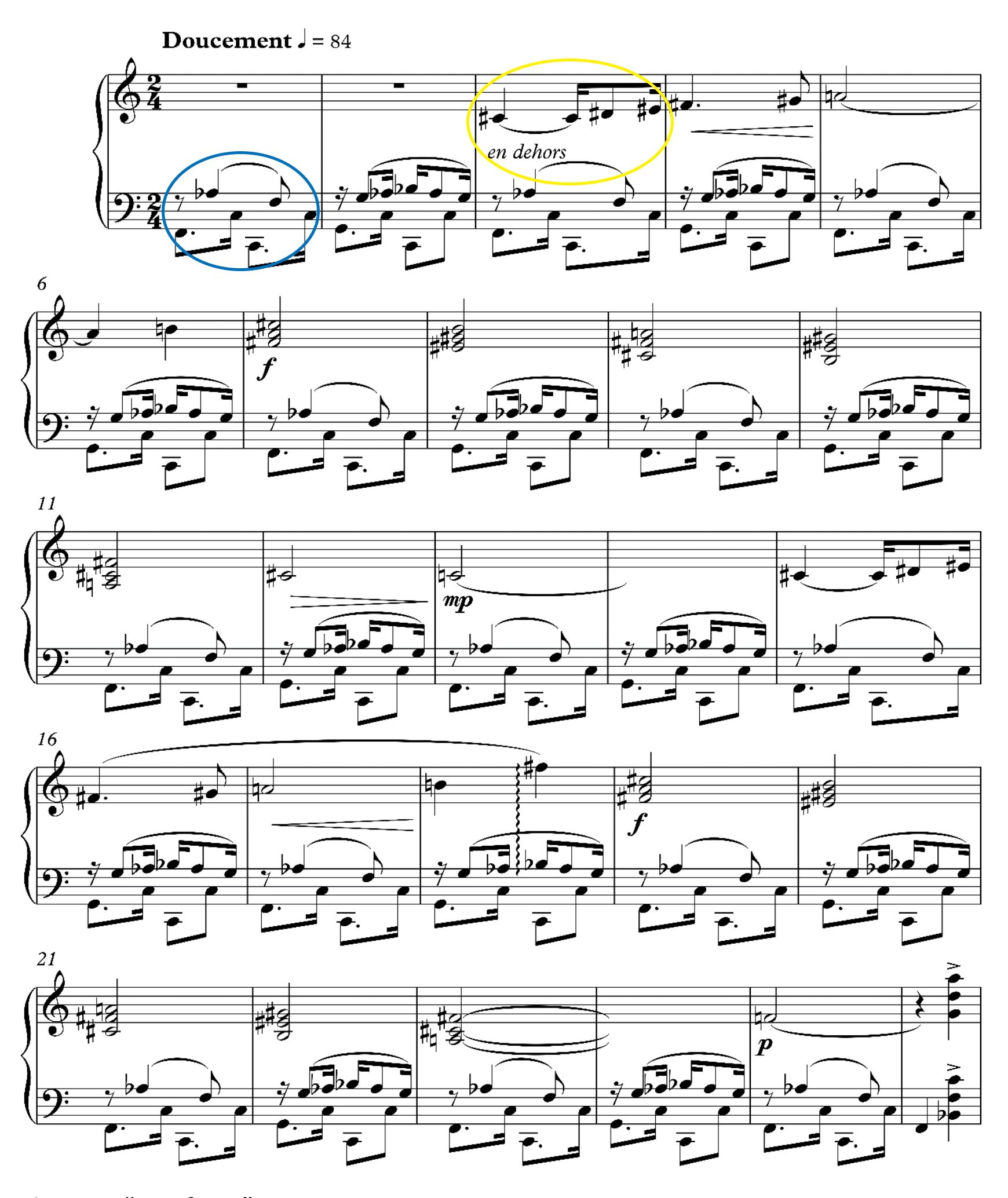
-Similarly, in "Botafogo" a bassline begins the piece and establishes the key of F minor in the left hand.
-In the right hand, in measure 3, the melody begins and establishes the key of F# minor.
-These two voices have more independance from one another. Not only are the keys fairly distant from one another but the prolonged common tone (C#/Db) is the flatted scale degree 6 from F minor (the controlling class). So compared to the previous example, these two keys share a more dissonant pitch class in common.
-Because of this, we will consider the subcenter class of F# minor to be more "resistant" to the bass provided by the controlling class (F minor).